


Harold Hall
Workshop Processes


The Plinth
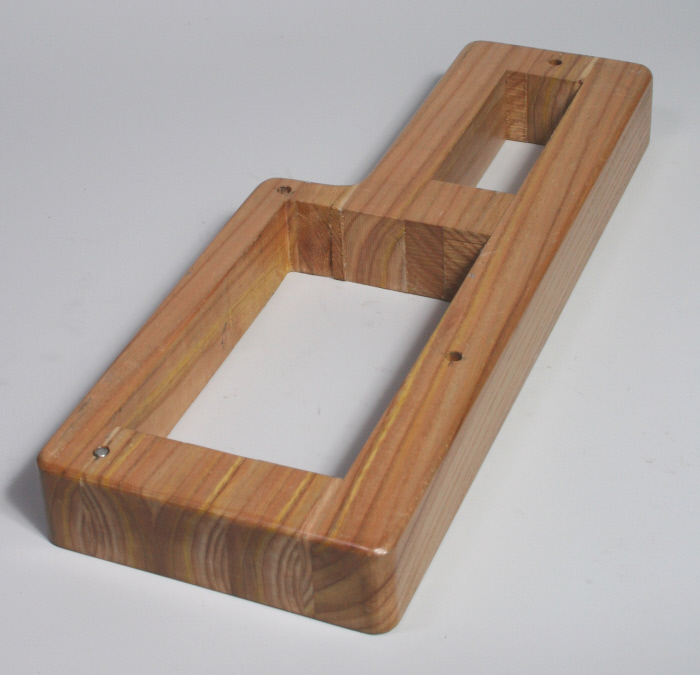
Readers may be interested in my method of making the plinth that avoids the need to make a cut out to take the flywheel, though this was not the reason for my adopting the approach. The plinth needs to be at least 35mm thick and whilst I had two planks that were thick enough these were earmarked for the legs of a dinning table. In any case they were sawn and would need thicknessing to check their grain patterns before I could decide if I could use a short length.
Viewers who do some cabinet making from time to time may be aware of the advice “to keep your timber as long as you can for as long as you can", in other words, use your short lengths before cutting short pieces from longer planks.
I had just one short piece available but this was only 25mm thick. By cutting strips
38mm wide and using these on edge the thickness required could be achieved. With
the strips available the plinth was fabricated as Photograph 28 shows and a use for
another small off-
Some final thoughts
Having completed the milling head it was almost a year before I found it possible to start work on the steam engine "Tina". During this time I began to have doubts as to whether the milling head would be a worthwhile proposition and had I wasted time and money on making it. However, having started the engine's construction I soon began to realise that my fears had been quite unnecessary. Of course, I had to accept that it could not perform in terms of size of workpieces possible and rate of metal removal as my much larger mill/drill, but I soon found that the satisfaction of using it was the equal if not greater than using my milling machine, especially as the parts being machined were so small. It is far superior to using a vertical slide as setting up for machining a component is so much easier on a horizontal table. The larger table and greater traverse also makes it easier as well as permitting larger components to be worked on.
A major plus was that I had power feed to both the saddle and the cross slide, my mill/drill being manual in both axis. This enabled me to make progress on other simple tasks, if only putting a few tools away that were not being used, whilst the milling head was completing a single pass. I would though add that I consider it essential that power feed of the saddle is always away from the head as the much greater traverse available makes a disaster much less likely should one become distracted for a short while. If you are unhappy with the idea then some simple form of warning device would be easy to set up.

28